
proven and successful.
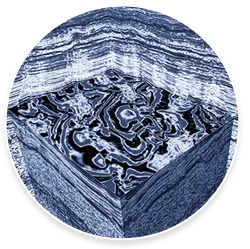
Frontier basins are characterized by a lack of geological and geophysical data or incomplete and fragmented data sets. Companies will mostly rely on costly and time consuming 2D and 3D seismic for prospect identification and development of potential drilling prospects. However, without a valid working petroleum system model in the basin, seismic will not differentiate if a trap is hydrocarbon charged or not.

Potential field methods (magnetics and gravity) are cost and time effective, and have long been used in the industry for frontier exploration. However, even if “frontier exploration teams acknowledge the use of gravity and magnetics as a key in basin evaluation, very few have strong knowledge of how to best apply these data” (Horn – first break – v31 Dec 2013).
PREMISE

Near surface sediments
are subjected to many bio/geochemical processes which lead to the dissolution of some minerals and the formation or alteration of new minerals.
Hydrocarbon migration (micro-seepage) is one of the causes of mineral alterations.
The most common mineral alteration is pyrite (FeS2), which occurs in the anoxic lower regions of the sediment column, where hydrocarbon sourced sulphide (H2S) reacts with detrital iron minerals to form pyrite – a stable mineral. However, other intermediate phases of coexisting iron sulfide minerals have been largely overlooked. Among these other minerals, is the (magnetic) mineral greigite (Fe3S4), a metastable mineral (greigite will remain stable, and not alter to pyrite, with the continued presence of hydrocarbon sourced sulphide (H₂S).
ESTABLISHED
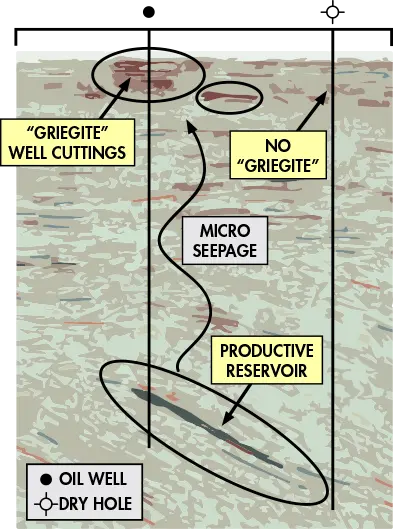
The mineral greigite is significant to hydrocarbon exploration…
it has been noted in drill cuttings from productive wells, which are associated with commercial oil/gas fields. In wells that are dry and non-commercial, greigite is absent in the drill cuttings.
Measurement
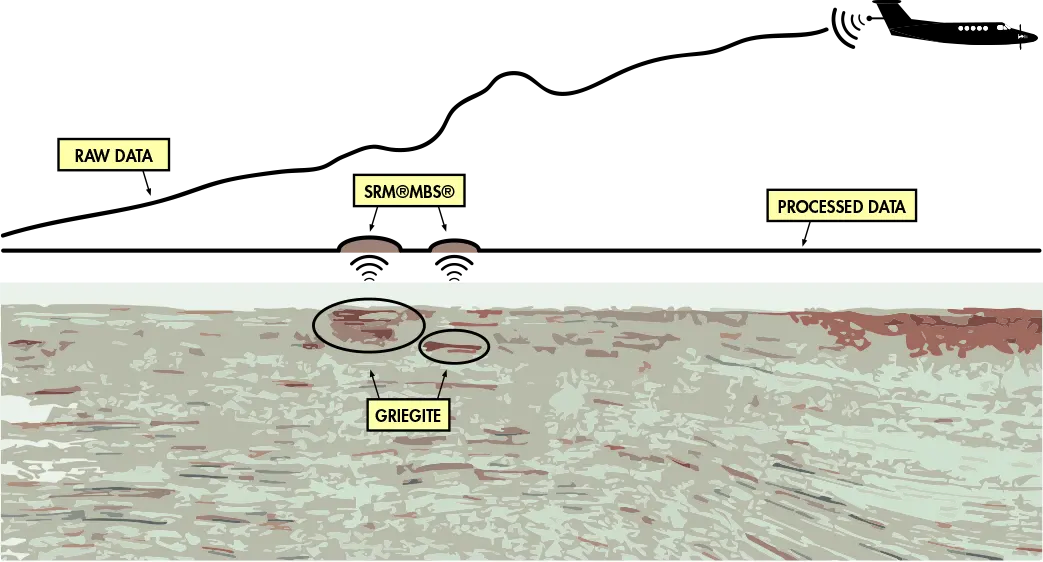
Since the mineral greigite is common to commercial oil/gas fields and is magnetic; the key to a successful frontier exploration program would be to precisely measure the magnetic response of the greigite. Hence, the development of SRM-MBS by Pilot Exploration. The SRM (Sedimentary Residual Magnetic) field generated from the mineral greigite is the result of accurate measuring and correct processing. The analysis and interpretation results in the MBS (Magnetic Bright Spot) anomaly that is associated with a commercial oil and gas field.
RESULTS

90% Success Rate
Pilot Exploration’s landmark study of the Deep Water trend in the Gulf of
America (GOA) validates the effectiveness of the technology in a large basin
setting. The results of GOA study exhibited a 90% success rate on 132 MBS
anomalies drilled and 119 new commercial field discoveries.
